

Maine Fly Fish
“Oh my god! There’s one following my fly! It’s huge!” Brandon’s shout echoed across the water, his excitement palpable. My son Tait looked over, shaking his head. “Did you forget to tell him not to yell when he sees one?” Brandon’s reaction, barely minutes into casting, perfectly captured the thrill—and challenge—of musky fishing. For me, it had been three long years since I’d last netted one, despite many near misses. Musky fishing is a game of persistence; missed hook sets, shy follows, and “musky fever” moments when you pull the hook too soon all come with the territory.
The week before, I had planned to guide a pair of regulars on a musky trip. When they canceled at the last minute, I decided to go for it myself and invited Stac to join. We hit the road at 5:30 a.m. and arrived at the lake around 9:30, eager to make the most of our first day. Within half an hour, Stac got a hit and thought she was snagged until she saw a musky swim away. In the crystal-clear water, the follows were thrilling to watch from a distance. We ended the day with five solid hits and one heart-stopping follow where a fish darted out from under the boat. Our second day was a stark contrast—four hours without a single fish sighting. Each day was a reminder of how unpredictable this pursuit can be.
When the next weekend rolled around, Tait, Brandon, and I set off for musky country. After his first thrilling follow, Brandon disappeared around a bend, out of sight. Minutes later, we heard a blood-curdling scream. We rushed over, only to find out that Brandon had hooked another big one but lost it. As Tait and I returned to our spot, Brandon stayed to fish the far side of the lake, eventually landing his first musky. After all his earlier shouting, his reaction was surprisingly calm when he finally held one. But that’s musky fishing—it’s more about the thrill of the chase than the catch itself.
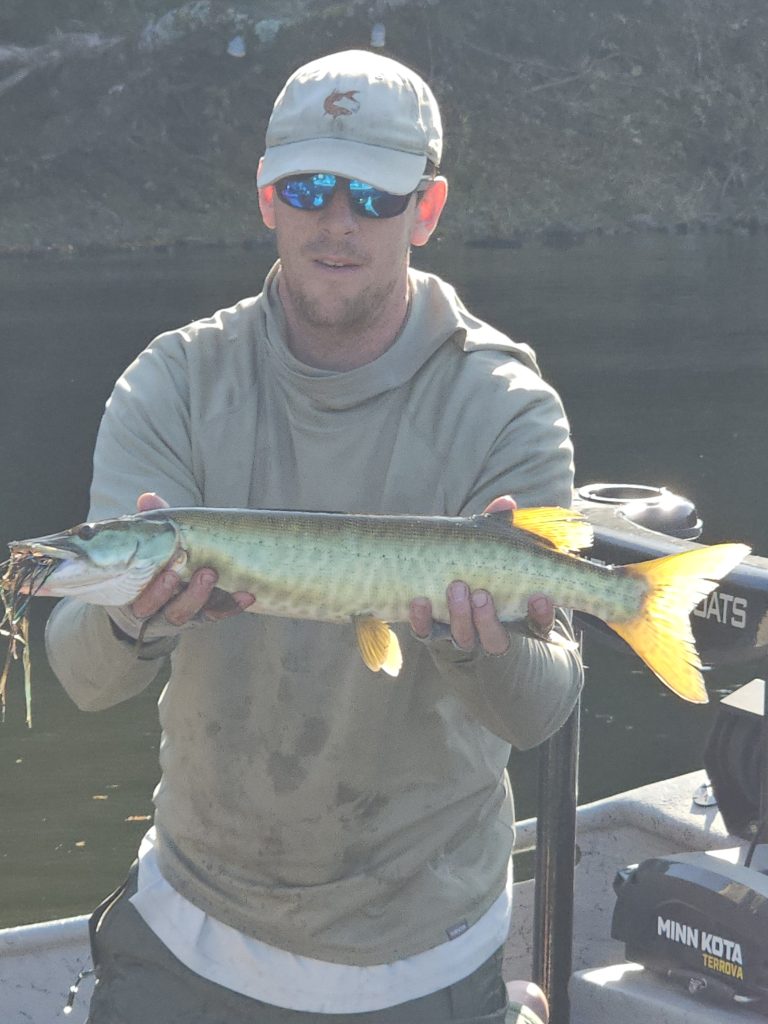
The day continued with high energy. At one point, Tait made a long cast and was stripping his fly back to the boat when a musky exploded on it just a few feet from the side. “Fish on!” he yelled. It wasn’t huge, but any musky in hand feels like a triumph. Hours later, I was starting to doubt my choice of fly and my retrieve speed. Brandon had multiple follows and one catch, as did Tait, yet I hadn’t seen a single fish. But that was about to change.
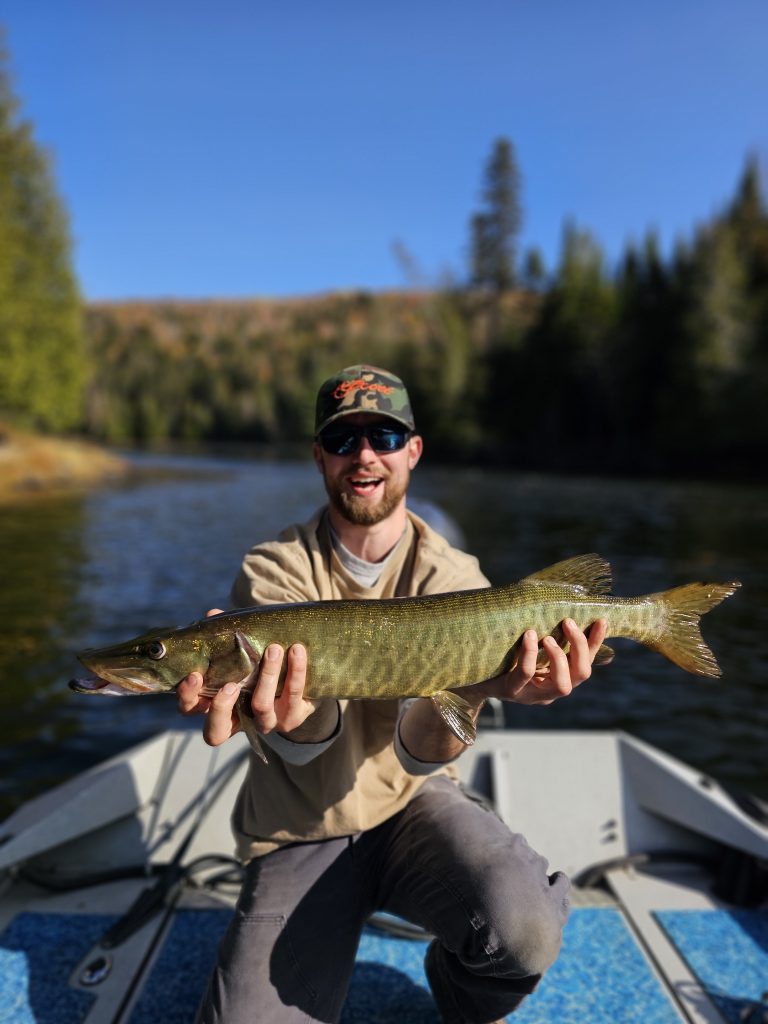
We spread out, covering different water depths, switching up flies, and targeting everything from the shallows to weed beds. I decided to downsize, tying on a black pike fly I’d made, and soon after, I caught my first musky of the trip—small, but a musky all the same. Brandon, now on a roll, landed another fish and had several more follows. By mid-afternoon, Tait was casting deep when he suddenly hooked into another musky. This was his second of the day, and his excitement was contagious. Shortly after, I had my own thrill when I hooked a personal-best smallmouth bass, a hefty 21 inches. I texted a photo to Brandon, who joked it could be a world record for fly rods. It’s something worth checking.
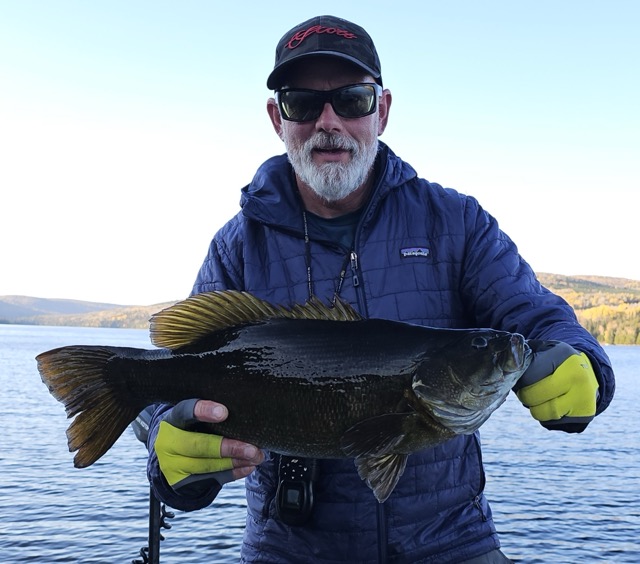
By the end of the day, we’d landed eight muskies and countless follows, most of them for Brandon. For a fish known for its elusiveness, it was an unusually good day.
Day Two: Fishing the River
On day two, we turned our attention to the river. Deep and dark, it made seeing follows nearly impossible. It was a stark contrast to the lake’s clear water, and given last week’s fruitless hours there, I had my doubts. But Brandon wanted to head out early, hoping to leave by noon for his six-hour drive home. The stakes felt high, with limited time to land a fish.
We split up and experimented with different fly patterns and retrieves. I switched to my trusted yellow and orange fly, hoping to entice a reaction. Tait and I cast toward the banks, mixing up fast and slow strips. When my fly stopped suddenly mid-retrieve, I thought it was snagged—until it moved. Unfortunately, the fish was gone before I could set the hook.
Frustrated but undeterred, I tried casting toward the middle of the river, against all my musky instincts. This spot, devoid of visible structure, was where I had once landed a 42-inch musky, so I always made a point to cast there. As I brought the fly near the boat, it suddenly halted. I set the hook hard, yelling, “Fish on! And it’s big!” Tait quickly reeled in and scrambled for the net, and moments later, we landed a solid 36-inch musky. In the musky world, 36 inches might not be a monster, but it’s an impressive catch nonetheless.
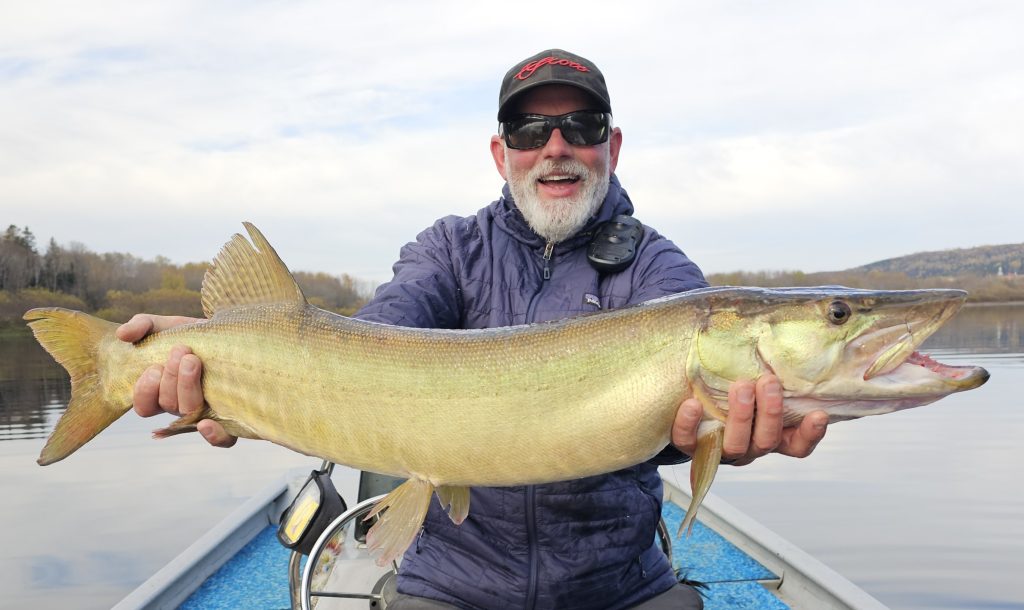
After celebrating with a round of high-fives and photos, we released the fish, and I couldn’t shake the realization that I’d missed a musky earlier that day. As Brandon packed up and hit the road, Tait and I continued fishing, though the river was quiet aside from a couple of late follows.
Reflecting on Maine’s Musky Magic
In two days, we’d landed nine muskies and had more follows than we could count—a rare feat in musky fishing. Maine’s musky fishery, though challenging, rewards patience and persistence. Musky are unlike any other freshwater fish; they are elusive, tough to hook, and require a steady hand even when adrenaline is surging. The satisfaction isn’t just in landing a musky; it’s in every follow, every glimpse of a fish beneath the surface, and every near miss that keeps you coming back.
If you’re eager to try your hand at musky fishing in Maine, hiring a local guide can save years of trial and error. It’s an investment that pays off, especially in a pursuit where the odds are never in your favor. But for those willing to take the time, Maine’s waters hold a world of excitement that makes each trip worth every cast.
