

Maine Fly Fish
Chasing Maine Musky on a Fly Rod: Three Days to Remember
By Kevin McKay
In 2016, I decided I wanted to catch a musky on a fly rod. I had never done it before, but I figured I could teach myself how to catch one.
As luck would have it, I was staying at a buddy’s house when I met another friend of his who was from northern Maine. He had fished for musky a few times and told me that orange and yellow flies worked well.
I went home and started watching YouTube videos about tying musky flies. Using what I learned, I came up with an articulated fly of my own. I had no idea if it would even work, but it did!
My First Musky Trip
For my first musky trip, I took my son Jax, who was 14 at the time. We got a hotel room and spent two days exploring the St. John River. We were going in blind, with only a little information about which boat launch to try.
At the launch, we met a local angler who told us to travel upriver to the ledges and look for eddies.
While we were talking, Jax had a musky follow his fly right at the boat launch.
He yelled, “There’s a fish!”
The local angler quickly told us that we would learn not to yell when we saw a musky because they spook easily.
It was May, and the water was very high. We traveled upriver and fished eddy after eddy. We had several follows, which is a huge part of musky fishing.
Over two days, we had 18 follows. Jax accounted for 15 of them and managed to land a 40-inch musky!
That trip was enough to get me hooked on musky fishing.
Making a Maine Musky Film
Three years later, I decided I wanted to make a film about Maine musky fishing for the Fly Fishing Film Tour. There was just one problem: I had never caught a musky myself. My wife, Stac, had never fished for them, and neither had my client Scott.
I reached out to local guide Del Harrington because we needed a second boat. He quickly agreed to help and even let us use his house during filming.
We had two film crews, two boats, and three people who were completely new to musky fishing.
Del gave us some starting spots, including one just upriver from where Jax and I had fished a few years earlier.
When filming began, the wind was blowing around 20 mph, and it even snowed. But we kept casting.
Over four days, we had plenty of follows and hookups, but only a handful of fish made it to the net. You’ll have to watch the film to see what happened!
Since then, I have spent many days chasing musky and have taken some of my clients north to try to catch their first one. I only guide fly fishermen for musky, which narrows down the number of people I can take, but that’s fine with me.
What Does It Take to Catch a Musky on a Fly?
Musky fishing is physically demanding, and you need the right equipment.
You should be comfortable casting 10- to 12-weight fly rods with 400- to 500-grain lines and flies ranging from 4 to 12 inches long.
You cast over and over again. Once the fly hits the water, you aggressively strip it back toward the boat. When the fly gets close, you work it in a figure eight right beside the boat before casting again.
Then you do it all over.
And over.
And over.
I have lost track of how many musky I have seen over the years, from little fish to one giant I estimated at around 50 inches. A year after seeing that fish follow my fly to the boat, I came across a photograph of someone holding a musky caught in the same area.
I have personally landed a 42-inch musky on a fly rod. It was August, pouring rain, and the wind was blowing around 20 mph.
Every musky I have landed is special because of how much goes into catching one. You can spend hours casting without a bite, and even getting a fish to follow your fly is an accomplishment.
That’s part of what makes musky fishing so addictive.
Three Days With Mark
Recently, one of my longtime clients, Mark, decided he wanted to try musky fishing. We had been planning this trip for more than a year.
He had previously fished with a guide in Virginia but had never seen a musky, so I think his expectations were pretty low. A few days before the trip, he started asking questions about flies and leaders.
I told him my goal was to get a follow first, then an eat, then a fish in the net. After that, we could work on getting a bigger one.
Mark drove up from Massachusetts on Friday, and we hit the road Saturday morning at 5 a.m.
During the three- to four-hour drive, Mark mentioned that he hadn’t seen a moose in many years.
Along the way, I noticed a car pulled over on the side of the road.
“They’re either peeing or they see a moose,” I said.
I was wrong. There wasn’t just one moose. There were four!
Mark got his wish before we even reached the river.
We had three days of fishing ahead of us, and Day One started with the wind blowing around 20 mph. That makes casting difficult, but it also makes controlling the boat a challenge. I need to keep the boat positioned so Mark can cast effectively.
We hadn’t been fishing for more than 30 minutes when he had his first follow!
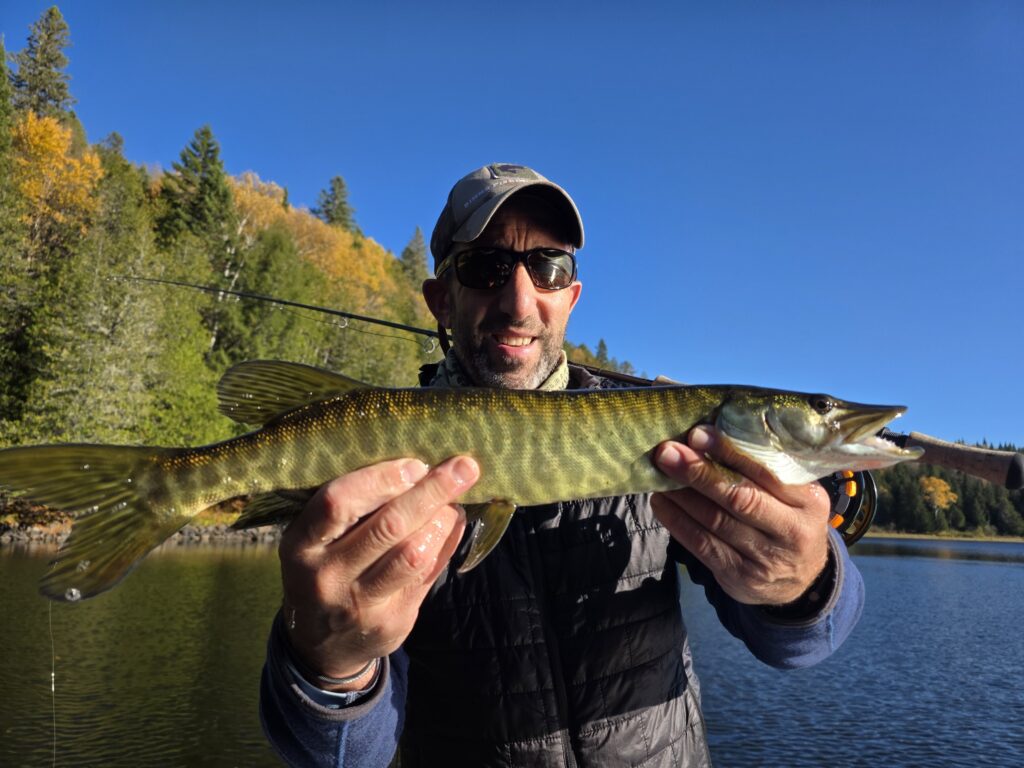
The wind forced me to try some new spots, and by the end of the day, Mark had seen 11 musky and landed his first one.
It measured 22 inches. Not a giant, but every musky is special, especially your first.
So far, the plan was working. We had the follows, and we had a fish in the net!
Day Two: Things Get Interesting
Day Two was completely different. There was hardly any wind, and the sky was cloudy.
Although we were fishing the same general stretch of river, I moved to different spots. The day before, all our follows had come on black flies, but Mark had caught his fish on yellow.
My plan was to start with a larger yellow fly in hopes of finding a bigger musky.
About 30 minutes into the day, I looked away for a second. When I looked back at Mark, he was hooked up!
I could tell he wasn’t convinced it was a big fish.
“It’s bigger than you think,” I told him.
Just then, the musky took off. Mark moved to the back of the boat as the fish made a powerful run. Because we were fishing deep water, the musky headed down and put up a tough fight.
Mark brought it close to the net several times, but each time we thought we had it, the fish took off again.
On our final attempt, the musky jumped, and the hook came free. Fortunately, I managed to scoop it into the net before it could swim away!
Mark had just landed a 30-inch musky.
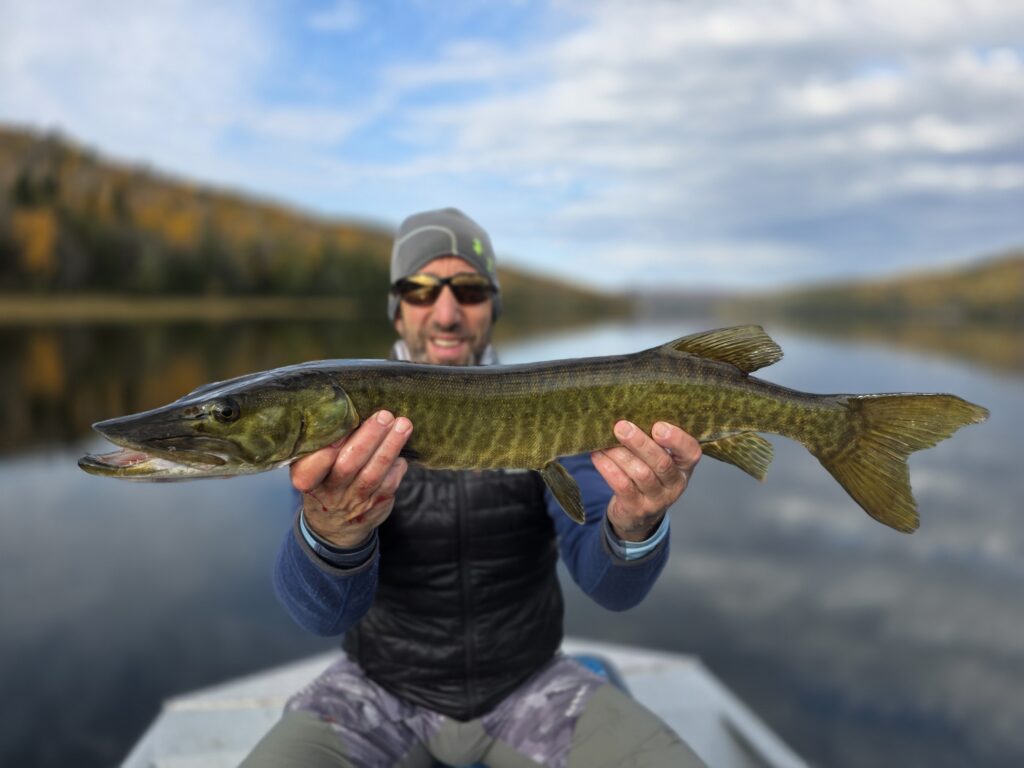
The day kept getting better. By the time we finished, Mark had experienced nine eats, four follows, and three landed fish. In addition to the 30-incher, he landed another musky measuring 25 inches.
But we weren’t done.
We found a bigger fish, one I estimated to be in the high 30-inch range. It followed the fly right to the boat and even looked like it was chewing on it, but it wouldn’t commit.
We changed flies four times and got the fish to follow five times, but it still wouldn’t eat.
Twice, it followed a small pink fly, a color I had never tried for musky before.
We decided to stick with pink for the rest of the day. Mark had three more follows on it, and the last one turned out to be his biggest fish of the trip.
A 34-inch musky!
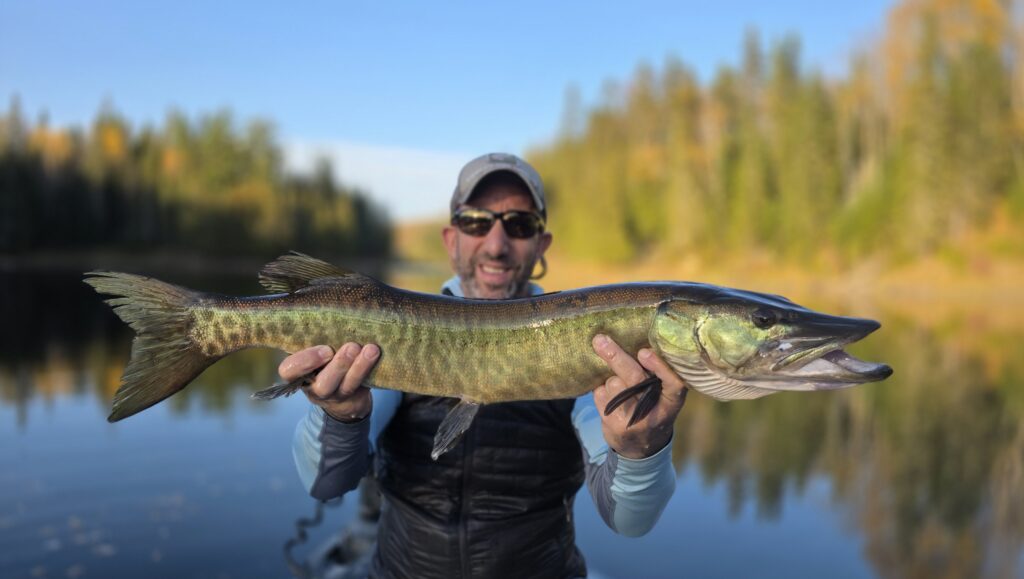
This fish was built differently. It had a much heavier body than the 30-inch fish, and it was impressive to see.
As I brought it to the net, Mark asked, “Now can I be done?”
He was exhausted!
After a day like that, I couldn’t blame him.
Day Three: One More Before Lunch
Day Three was even tougher, with high winds and rain.
We moved only three fish that day, but one was around 40 inches. We tried several flies to get it to follow again, but it never showed itself.
Around noon, I suggested we eat lunch and let the boat drift. After eating about half my sandwich, I decided to make a few casts. Catching a musky during a lunch break isn’t something you count on, but it was worth a try.
On one cast, I hooked the bottom. The water was only about two feet deep, and after I managed to get the fly unstuck, I cast toward the middle of the river.
The fly hit something almost immediately.
At first, I thought I had hooked the bottom again. Then it moved.
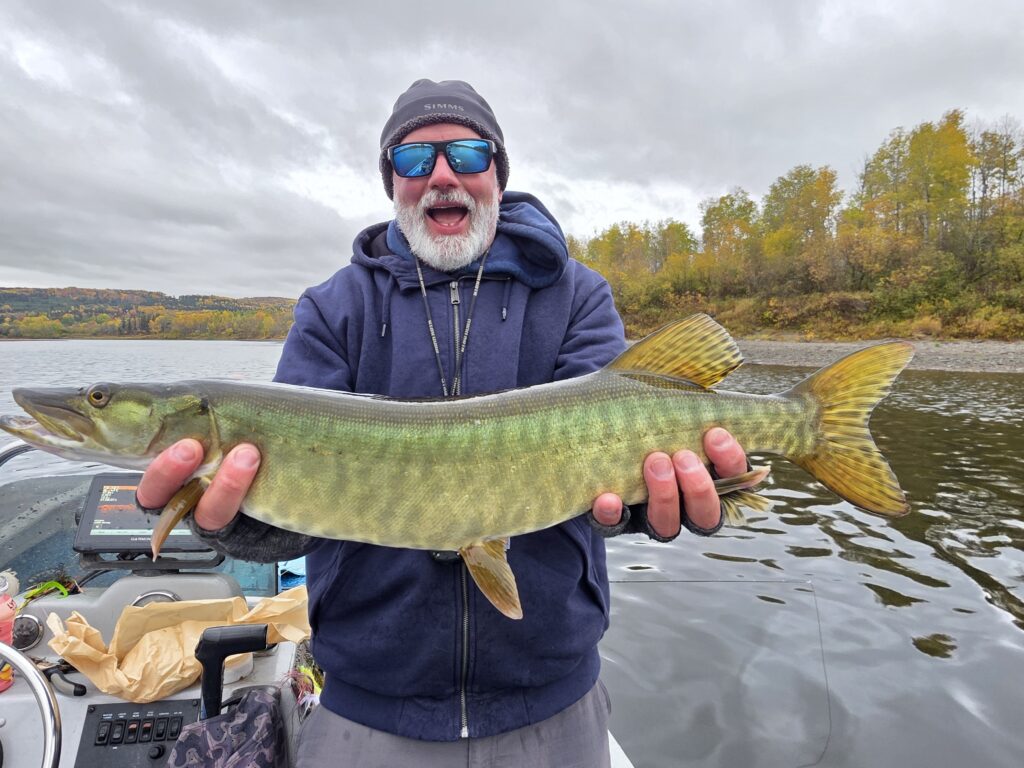
I had caught my lunch-break musky!
It measured 25 inches.
We never moved another fish that day, but what a trip!
Over three days, we saw more than 20 musky and landed five.
Mark got to experience just about every aspect of musky fishing. He saw fish follow his fly, experienced the excitement of an eat, fought several fish, and landed his first musky, his biggest musky, and several others along the way.
We dealt with high winds, rain, changing conditions, and fish that followed but refused to eat. We also had incredible action and a trip neither of us will soon forget.
Why I Keep Chasing Musky
Musky fishing isn’t for everyone. It takes patience, physical effort, and the ability to keep casting even when you don’t know whether the next fish will show itself.
You might see a giant follow your fly all the way to the boat and refuse to eat. You might spend an entire day working for a single opportunity. And sometimes, just when you think you’ve hooked the bottom, you discover you have a fish on the end of your line.
That’s musky fishing, and it’s why I keep going back.
Mark and I are already planning his next trip. Next time, we’ll be looking for an even bigger one!
If you’re interested in experiencing Maine musky fishing on a fly rod, you can learn more about my guided fishing trips through Maine Fishing Adventures. I specialize in fly fishing and help anglers experience some of Maine’s most exciting fishing opportunities.
You can also find more fishing stories, reports, and information here at MaineFlyFish.com.
