

Maine Fly Fish
Dry fly season is upon us in Maine! The words “Hex Hatch” and “Green Drakes” have been buzzing around recently because the water temperatures and photoperiod (length of sunlight during the day) are just right to initiate these hatches.
It has been my experience that you will find both Hexs and Eastern Green Drakes emerging on the same ponds in Maine – usually within the same time during the day! Some anglers don’t give a rip on how to tell the difference between the two, and that’s fine! Pick a mayfly dry fly pattern (Adams or Wulff style) that is similar in size to the mayflies that are coming off the water, tie it on, and you’re set. If you’re an entomology geek, like myself, you may be curious on how to tell the two apart. Let me give you the scientific answer…
Scientific classification: Latin/Scientific name (Common Name)
Order: Ephemeroptera (Mayflies)
Family: Ephemeridae (Common Burrower Mayflies)
Both the Eastern Green drake and the Hexagenia are under the mayfly family, Ephemeridae, the common burrowing mayflies but are of a different Genus. The nymphs of the Hex and Green Drakes are VERY similar. Both are long bodied burrowing mayflies that dig into the substrate and live in U shaped burrows. They both contain tusks on the front of their head (used for digging burrows) and feathery looking gills on top of their abdomen.

Notice the ‘tusks’ and dark feathery gills above of burrowing mayfly nymphs.
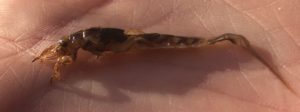
Had to take a quick snap of a nymph that was regurgitated from a brookie my client recently caught.
However, the frontal process (front of head when looking down onto it) of the green drake nymphs will be forked and the front of the head of the Hex will be rounded. This will be your only real distinguishable difference in nymphs using the naked eye. Diving a little deeper, the abdomen of mayflies are split into 10 segments, with the 1st being attached to the thorax and the 10th being attached to the caudal filaments (or tails!). The 1st abdominal segment on the Hex nymph will have double gills while the 1st abdominal segment on the green drake will have single gills. Phew! Alright, moving onto identifying adults.
Usually in Northern Maine, the Eastern Green Drake are about half the size as the adult Hex and are green/yellow in color compared to yellow/brown. Although, size and color can differ from pond to pond so these are not the first characteristics I use to tell them apart. The first real noticeable difference is that the adult eastern green drake will have three long caudal filaments (three tails!) and the Hex will only have two caudal filaments. Additionally, the green drake will have distinct dark spots (mottling) on its forewings and the Hex has cross veins on its wings.
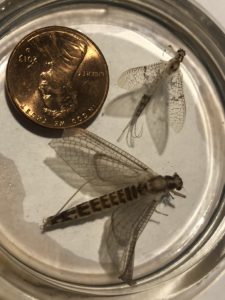
Ephemera (top) and Hex (bottom) showing the difference in size and mottling on the wings on the Ephemera versus the dark cross veins on the Hexagenia. Notice one of the tail filaments is broke off on the Hex.
Just to throw you for a loop – there is another large body mayfly adult (very similar to the Hexagenia adult) that hatches in Maine called the Dark Green Drake (Genus: Litobrancha) – however it is much less common than the Hex.
I will now insert a plug of why scientific names can be useful in correctly distinguishing species instead of using common names. However, that is the fun thing about this sport — you can get as in depth as you would like in some topics and just skim the surface in other categories. (:
Thanks for reading! Hook sets and heavy nets!
Megan
