Maine Fly Fish


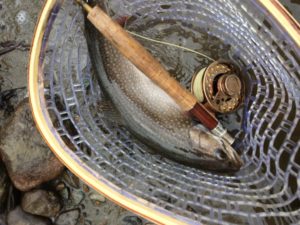
Early season brookie on a white streamer
It’s been a while since I’ve posted on The Educated Angler blog. I’ve been busy tying flies and spending time with family in anticipation of being on the water a lot in May and June. I had posted several blog posts for beginners over the winter, and I’ve been thinking about what would be a beneficial post for newer anglers here in Maine versus just posting about a topic that has been beaten to death.
I’ve decided to post about early season trout fishing in rivers. In case you didn’t know, Maine is kind of divided into Northern Maine and Southern Maine. Currently, there are budding trees and lawnmowers running in Southern Maine. Head three hours north from Portland and you’ll likely encounter a decent amount of snow still sticking around in the woods. Ice is still on lakes in the north, and people have been out in their boats for a couple of weeks here in the southern part of the state.
There is one common theme for both parts of Maine at this point in time, and that is high water in the rivers from runoff. Many of the rivers in southern Maine are stocked with trout in May and June. Some are stocked earlier, but Maine IFW are likely waiting for the rivers to calm down a bit before they dump a bunch of trout in the rivers. Water temps will likely be in the low 40’s but will rise into the 50’s by the end of Maine.In the north country, water temps will take a longer time to climb and this is important because different temperatures often indicate what food will be abundant for trout.
I’m going to give you a timeline of how I chase trout in the early season, and by early season, I mean late April to Memorial Day. I’ll also talk about what flies I use, and will post some generic patterns, but I take great pride in my job as a guide and I’d rather not share some of my variations to these flies that I’ve found to be more successful. I can’t give it all away for free!!
Trout Timeline:
Southern Maine
In late April, I start fishing some rivers in southern Maine that are traditionally stocked at this time and also have some holdover trout that I find each year. I determine that they’re holdovers because they’re often bigger than what the stocking report says for the recently stocked fish. I don’t stray too far from parking areas this time of year because most stocked trout are moving around a lot yet. I won’t get into the behavior of stocked trout too much, but let’s just say they don’t get stocked and then go on a long journey 🙂 I like to fish smaller versions of streamers that I’d fish for bigger, wild trout with. For instance, I fish Mickey Finn’s, Woolly Buggers and Black Ghosts in size 12, instead of a typical size 6 or 8 streamer. I find these patterns to be very successful when fishing the head of a pool with a slow jigging motion, instead of fast strips and retrieves.
If you fish in a river that has suckers, you’d be smart to fish egg patterns once you see suckers stacking up together. I like to put on two different egg patterns with enough split shot to keep it on the bottom. I’ve had stocked trout take my egg pattern as it rises up in the water column. Definitely not a natural event, but those “stockies ain’t so smart bub”.
In mid-May, I continue fishing in southern Maine. Around the 3rd week of May, I start seeing some surface activity and I find that a small EHC or klinkhamer are all that I need. You won’t see a lot of rising fish, but I like to put away the streamers and just watch fish rise this time of year. I take my time and don’t keep throwing casts. Watch the same fish rise a few times first, then go attack. You’ll be more successful than if you just keep throwing that dry all over the place and disturbing the pool.
Northern Maine
Once the rivers settle in early May, I start fishing in the north country a little more. The water temps are still low, and you likely won’t catch a lot of fish. Some years, I’ll fish for 6 hours and land one or two trout. Other years, I’ll fish for 2 hours and catch 6 or 7 trout. Every year seems different. I like to start with white streamer patterns (black ghosts, mini dungeons, deceivers). I don’t put a lot of action on the fly. I mostly swing, sometimes with a pulsating twitch and other times just dead drifting it. I’ve had more success just dead drifting white streamers, which can often imitate dead or stunned smelt.
Once the temps reach the low 40s, I start switching over to fishing with more nymphs. If you get a warmer day, flip some rocks and you’ll start to see lots of activity going on down there. Some of my favorite nymph combos at this time are “turd and worm” or “steak and eggs”. A “turd and worm” combo generally consists of a buggy stonefly nymph as the lead fly and a worm pattern as a dropper. The “steak and eggs” combo for me is a woolly bugger as the lead fly and an egg pattern behind it. If you get on a river where suckers spawn, usually in mid-May, having the right colored egg pattern, usually yellow or white, can be the difference between a slow day and a great day. I fish eggs like crazy in the month of May, and have had some great fish in the net because of it. As the month winds down, you likely won’t find many fish rising yet, so other nymph patterns like caddis larva, pheasant tails or hare’s ear nymphs will get you hooked up.